
September 2, 2026
Data management has always had a labor problem. The practices that keep data reliable, such as deduplicating records, checking quality, classifying content, and documenting what exists, are exactly the tasks that teams postpone because they are repetitive and never urgent. The backlog grows quietly until a migration, an audit, or a bad report forces someone to deal with it.
AI augmented data management is the application of machine learning to precisely this layer of work. The term describes tools where AI does not replace the data management practice but takes over its most repetitive parts, while people keep the decisions. Understanding what that means concretely, and where the limits are, helps separate the useful implementations from the marketing.
Where AI Actually Helps Today
The capabilities below are established and available in commercial tools, not speculative.
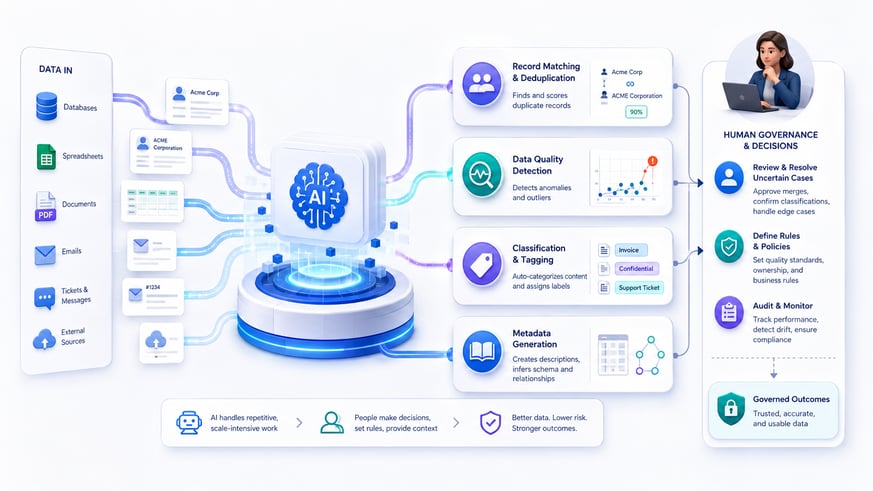
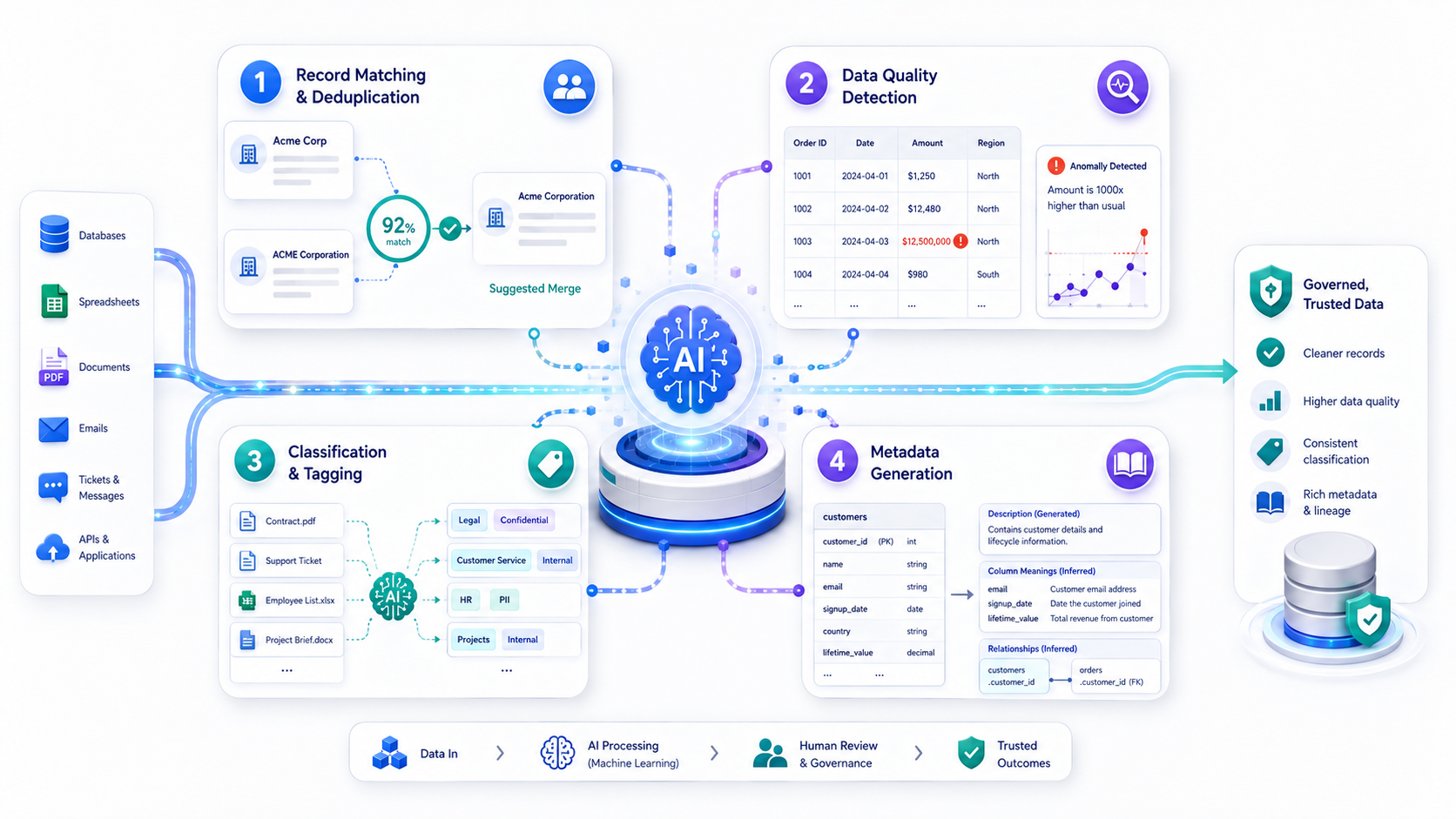
Record matching and deduplication. Deciding whether "Acme Corp" and "ACME Corporation" are the same company used to require rules that broke on every edge case. Machine learning models compare records across many attributes at once and score the probability of a match, which handles the messy variations that rule-based matching misses. This is currently the most mature and useful application.
Data quality detection. Instead of checking values against predefined rules, models learn what normal looks like in a dataset and flag what deviates from it: an order of magnitude error in a revenue field, a date that breaks the usual sequence, a category that has never been used before. The strength of this approach is catching problems nobody wrote a rule for.
Classification and tagging. AI can read a document, a ticket, or a record and assign categories, sensitivity levels, or topics. For organizations that need to know where personal data or confidential material lives across their systems, automated classification turns an impossible manual task into a manageable review.
Metadata generation. Data catalogs have historically failed because they depend on people documenting their datasets, which people do not do. AI that reads a table and drafts its description, infers column meanings, and maps relationships between datasets removes the main reason catalogs go stale.
What AI Does Not Solve
The honest boundaries matter more than the capabilities, because this is where implementations fail.
AI does not decide what "correct" means. A model can flag that two customer records probably refer to the same company, but whether they should be merged, and which value survives, remains a governance decision. Organizations that have never defined ownership and rules for their data will find that AI accelerates the confusion rather than resolving it.
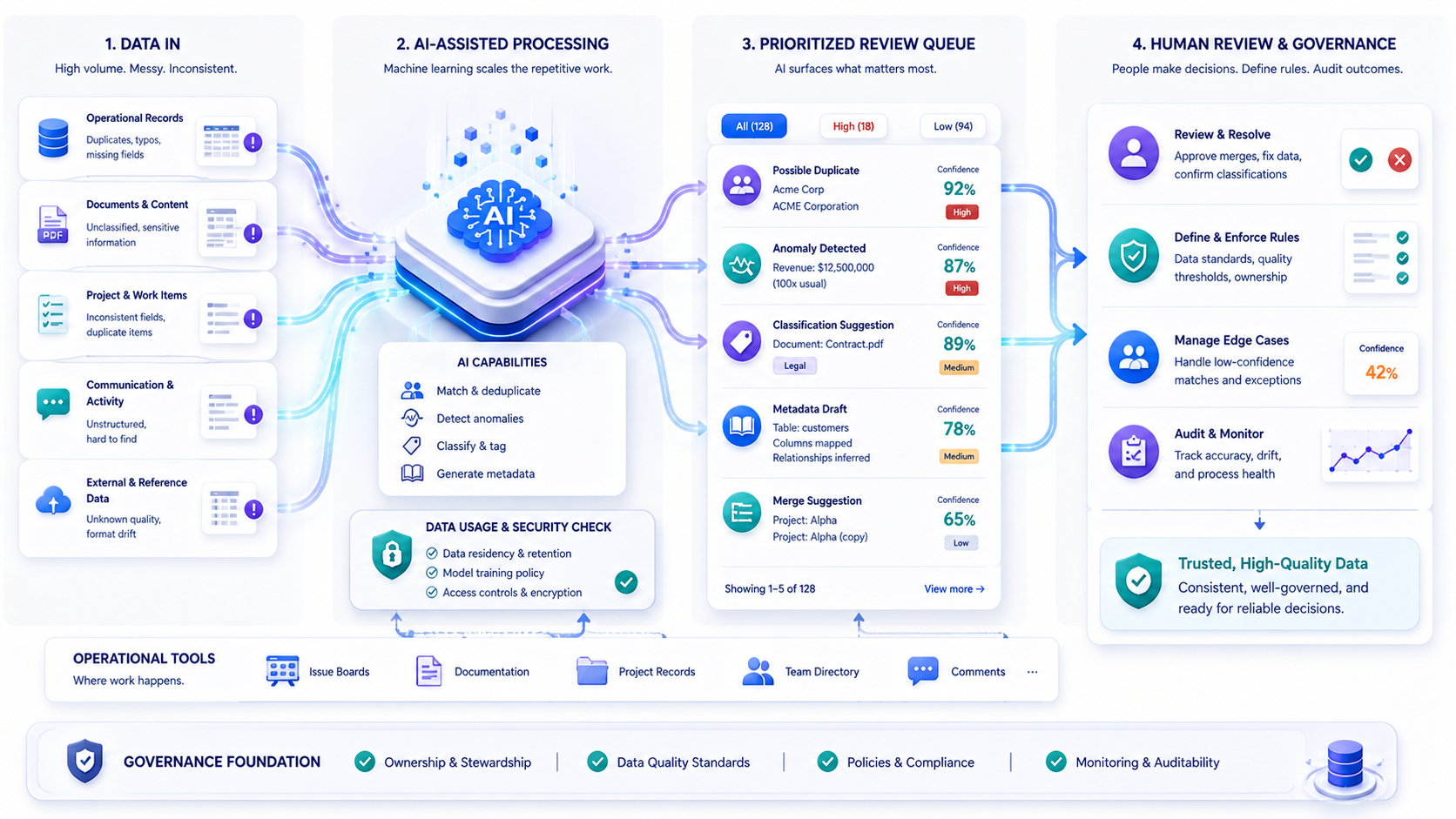
Accuracy is probabilistic. Matching, classification, and anomaly detection produce confidence scores, not certainties. Every serious implementation keeps a human review step for low-confidence cases, and the volume of those cases depends on how clean the data was to begin with.
And the quality of the underlying data still sets the ceiling. Models learn from the data they see. If the existing records are inconsistent, sparse, or wrong, the suggestions built on them inherit the same problems. AI augmented data management works best as an amplifier of practices that already exist, which is the same conclusion covered in our guide to data management tools: the practice comes before the tooling.
What Changes for the Team
The practical effect of these capabilities, where they work, is a shift in what data work looks like.
Less time goes into finding problems and more into resolving them. A quality process that used to mean sampling records manually becomes reviewing a queue of flagged anomalies. A deduplication project that used to take a quarter becomes an ongoing review of suggested merges. Documentation that never happened starts existing in draft form, waiting for correction rather than creation.
The skill profile shifts with it. The valuable work moves from executing checks to defining them: deciding what the rules are, judging the edge cases the model is unsure about, and auditing whether the automation is drifting. This is why AI augmented data management tends to reduce the toil of data work without reducing the need for people who understand the data.
What This Means for Data in Work Management Tools
Most of the AI data management market is built for large analytical environments, such as warehouses and lakes. But the same pattern is arriving in operational tools. Platforms increasingly suggest field values, detect duplicate items, and classify content inside the systems where work happens.
For teams whose operational data lives in Jira, Confluence, or monday.com, this cuts both ways. The data in those tools, including project records, customer context, and team activity, is precisely the kind of high-volume, inconsistently maintained material that benefits from automated quality and classification. At the same time, AI features operating on your operational data raise a question that did not exist before: what the vendor does with that data, and under what conditions. Evaluating AI capabilities and data usage policies together, rather than separately, is becoming a standard part of choosing tools.
The structural point stays the same regardless of the AI layer. Automated quality and matching work best when data flows through connected systems rather than accumulating in disconnected ones, which is the problem covered in our guide to what a data integration hub is.
FAQ
What does AI augmented data management mean?
It refers to data management tools and practices where machine learning handles the repetitive parts of the work, such as matching duplicate records, detecting quality issues, classifying content, and generating metadata, while people keep control of the rules and the decisions. The term emphasizes augmentation: AI accelerates an existing practice rather than replacing it.
How is AI used in data management today?
The most established applications are record matching and deduplication, anomaly detection for data quality, automated classification of documents and records, and metadata generation for data catalogs. These are available in commercial tools today and deliver measurable time savings, provided the organization has defined the governance rules the AI operates within.
Does AI replace data governance?
No. AI executes and accelerates governance, but the decisions that define it, such as who owns which data, what quality standards apply, and how conflicts are resolved, remain human responsibilities. Organizations without established governance typically see AI tools amplify their data problems rather than fix them.
What are the risks of AI in data management?
The main ones are overtrusting probabilistic outputs, which leads to wrong merges and misclassifications propagating silently, and applying AI to data that is too poor to learn from. A third, increasingly relevant risk concerns the vendor side: understanding whether and how the provider uses your data to train its models should be part of evaluating any AI-enabled tool.