
July 15, 2026
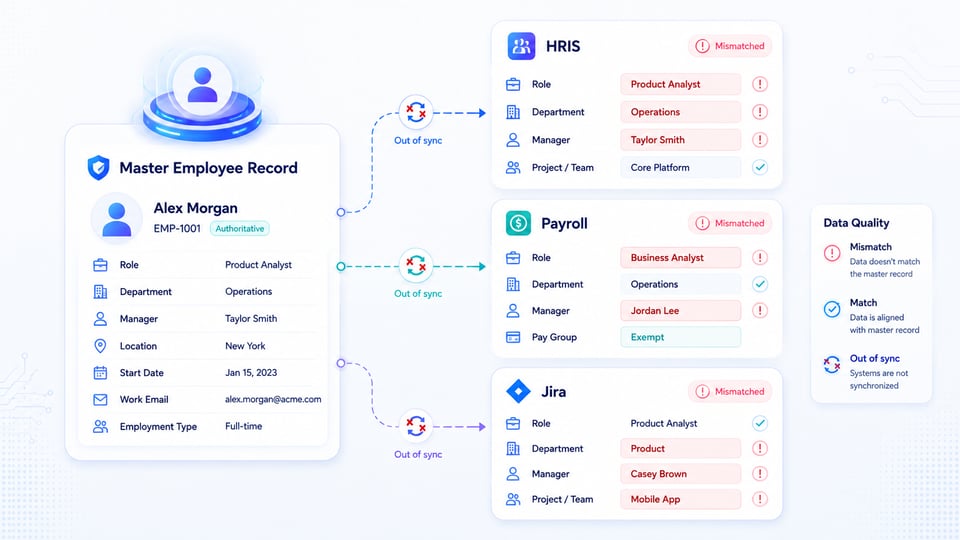
Every organization has a version of the same problem. A new employee joins and their record gets created in the HRIS. A week later, someone adds them to the payroll system. A month in, their manager assigns them to a project in Jira. Three months later, they change roles, and the update reaches two of those three systems but not the third.
Nobody made a mistake. Each system was updated by the person responsible for it, at the time they had the information. But the result is that the same person now has three slightly different records across three different tools, and the next time someone needs accurate data about them, they will have to reconcile the differences manually.
HR master data management is the practice that prevents this from happening at scale.
What HR Master Data Management Means
The core idea is straightforward: for any category of data that needs to be accurate and consistent across multiple systems, there should be one authoritative source. All other systems either reference that source or synchronize from it. When the source is updated, the change propagates. When systems disagree, the source wins.
Applied to HR, this means designating a single authoritative record for each employee: a master record that contains the definitive version of their name, job title, department, employment status, compensation, and any other attributes that other systems need to reference.
This is distinct from simply storing HR data in one place. Many organizations store HR data in an HRIS but still end up with inconsistencies because other systems maintain their own copies and update them independently. Master data management is not about where the data lives. It is about which version is authoritative and how changes flow from that version to everywhere else.
Why Employee Data Becomes Inconsistent
Inconsistency in employee data is rarely the result of negligence. It is usually the result of how systems are added to a stack over time.
Each tool that needs employee data tends to build its own internal representation of it. The payroll system has its own employee table. The project management platform has its own user directory. The access management system has its own identity records. When a change happens, such as a promotion, a name change, or a department restructure, each system needs to be updated separately. The more systems there are, the more likely it is that at least one update gets missed.
The problem compounds with time. A minor inconsistency that goes unnoticed for a month becomes embedded in reports, audit trails, and downstream systems. Fixing it retroactively is more expensive than preventing it.
The Components of HR Master Data Management
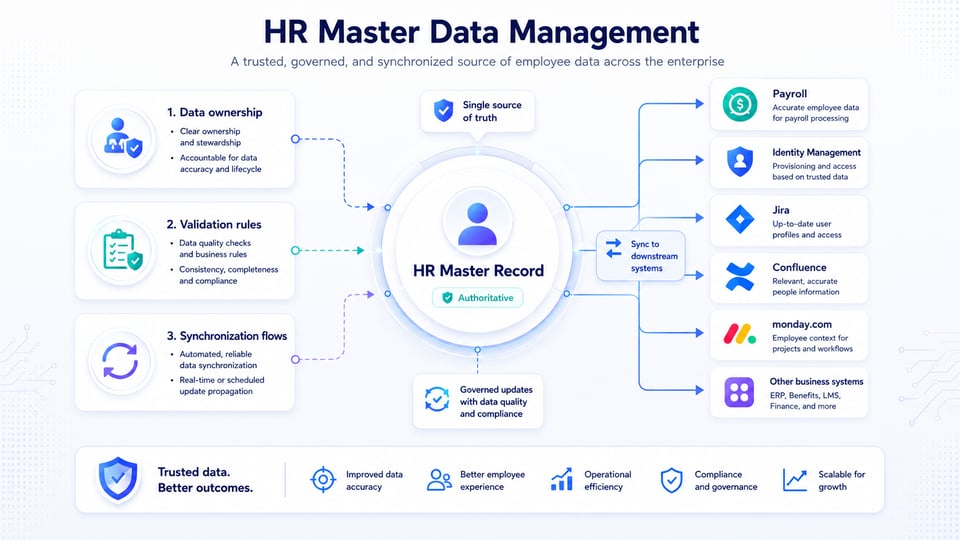
Building a functional HR master data management practice requires decisions in three areas.
Defining the master record. The first step is deciding which system holds the authoritative version of each HR data attribute. For most organizations, the HRIS is the natural home for core employee records. But the decision needs to be explicit: every team that manages HR data needs to know which system is the source of truth and what happens when another system shows a different value.
Governing data quality. A master record is only as useful as the processes that keep it accurate. This means defining who is responsible for updating each attribute, how quickly updates need to be reflected, and what validation rules apply. A job title field with no controlled vocabulary will accumulate variants over time. A department field with no ownership will drift out of sync with the actual org structure.
Managing data flows between systems. Once the master record is defined, the next challenge is keeping downstream systems synchronized with it. For organizations with a small number of tools and infrequent changes, manual processes or simple integrations may be sufficient. As the stack grows and change frequency increases, more structured integration architecture becomes necessary. Our guide to what is a data integration hub explains how this layer works when point-to-point integrations are no longer enough.
HR Master Data and Work Management Platforms
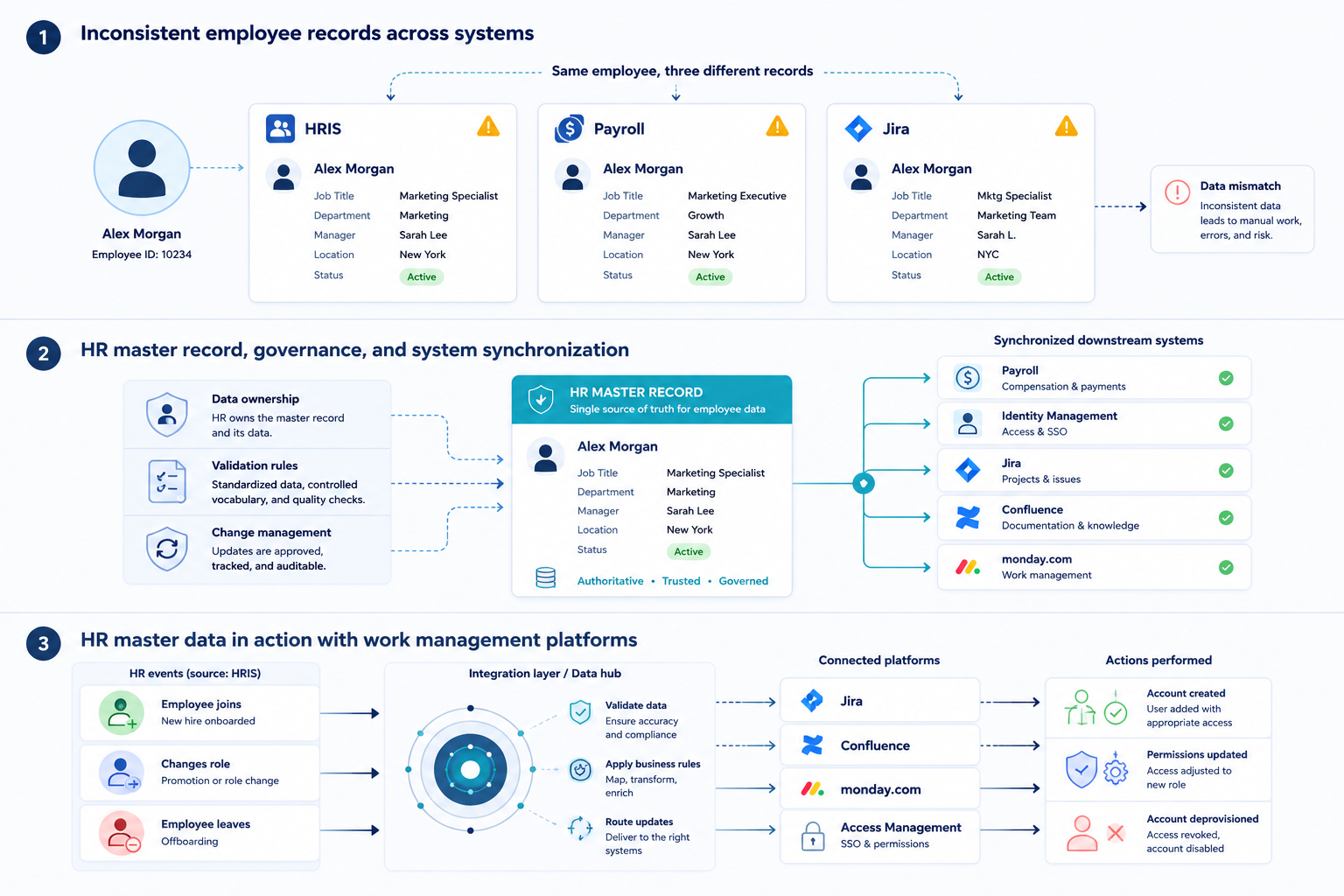
For teams using Jira, Confluence, or monday.com, HR master data management has a practical dimension that often goes unaddressed.
These platforms maintain their own user directories. When an employee joins, their account needs to be created. When they change roles, their permissions may need to change. When they leave, their account needs to be deprovisioned. Each of these events originates in HR but has consequences in tools that are managed by IT or by individual team administrators.
Without a connection between the HR master record and these platforms, the synchronization happens manually or not at all. The result is access control gaps: people with permissions they should not have, or without access they need. In a compliance context, particularly for organizations subject to data protection regulations, these gaps carry real risk.
Keeping HR master data synchronized with work management tools is one of the concrete use cases where structured data integration adds measurable value. For a broader view of how HR data management fits into an organization's overall data practice, our guide to HR data management covers the full picture.
Common Challenges in HR Master Data Management
Lack of ownership. Master data management fails when nobody is clearly responsible for maintaining the master record. In many organizations, HR data is maintained by multiple teams with overlapping but undefined responsibilities. Establishing explicit ownership is a prerequisite for consistent data.
Too many systems with write access. If multiple systems can update the same employee attribute independently, inconsistencies are inevitable. The master record should be the only system with write authority for each attribute. Other systems should read from it, not write to it.
Infrequent audits. Even well-managed master data drifts over time. Regular audits that compare the master record against downstream systems catch inconsistencies before they become embedded in reports and processes.
Offboarding gaps. HR master data management tends to be most rigorous at onboarding and least rigorous at offboarding. When an employee leaves, their master record needs to be updated promptly so that downstream systems, including access management and work management platforms, reflect the change accurately.
FAQ
What is the difference between HR master data management and general HR data management?
HR data management covers the full range of practices for collecting, storing, governing, and using people data across an organization. HR master data management is a specific discipline within that broader practice: it focuses on maintaining a single authoritative source for core employee attributes and ensuring that other systems stay synchronized with it. Our guide to HR data management explains the broader context.
Which system should be the master record for employee data?
For most organizations, the HRIS is the natural choice because it is designed specifically for employee data and is typically maintained by HR. The more important factor is that the decision is explicit and consistently enforced. Whatever system is designated as the master record, all teams that manage employee data need to know it and operate accordingly.
How do you keep downstream systems synchronized with the HR master record?
The approach depends on the number of systems and the frequency of changes. For small stacks, manual processes or simple point-to-point integrations may be sufficient. For larger stacks with frequent changes, a more structured integration layer that routes updates from the master record to all connected systems is more reliable and easier to maintain.
What happens when two systems show different values for the same employee attribute?
When a conflict exists between the master record and a downstream system, the master record is authoritative. The downstream system should be corrected to match it. If conflicts occur frequently, it is a signal that the data flow between the master record and that system is not working correctly and needs to be reviewed.
Is HR master data management only relevant for large organizations?
The complexity that makes master data management necessary scales with the number of systems and the rate of change, not directly with organization size. A fast-growing company of fifty people using six or seven tools may need more structured master data management than a stable organization of five hundred using two well-integrated systems.