
June 17, 2026
HR teams generate more data than most people realize. Every hire adds a record. Every contract change updates a file. Every performance review, payroll run, onboarding checklist, and offboarding process leaves a trail of information that needs to be stored, maintained, and accessible to the right people at the right time.
For small teams, managing this data is straightforward. A spreadsheet works. A shared folder is enough. The problems start when the organization grows, the tools multiply, and the same employee information ends up living in different places, maintained by different people, on different schedules.
HR data management is the set of practices and systems that prevent this from happening.
What HR Data Management Covers
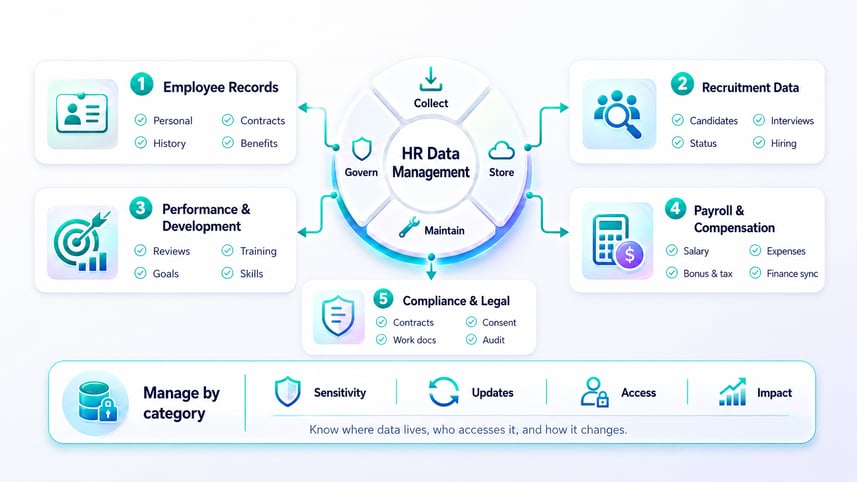
HR data management refers to how an organization collects, stores, maintains, and governs data about its people. This includes:
Employee records. Personal information, employment history, contract terms, compensation, benefits enrollment. The foundational layer that every HR process depends on.
Recruitment data. Candidate profiles, application status, interview notes, hiring decisions. Often stored in an ATS but frequently referenced by hiring managers working in other tools.
Performance and development data. Review cycles, goal tracking, training completions, skill assessments. This data tends to be fragmented across HR platforms, project management tools, and spreadsheets.
Payroll and compensation data. Salary history, bonuses, tax information, expense records. Usually managed in dedicated payroll software but often needs to connect with finance and HR systems.
Compliance and legal data. Employment contracts, right-to-work documentation, consent records, audit trails. This category has the highest stakes for data accuracy and access control.
Each category has different sensitivity levels, different update frequencies, and different audiences. Managing them well means knowing not just where the data lives, but who can access it, how it gets updated, and what happens when it changes.
Why HR Data Management Becomes Critical as Organizations Grow
At ten people, HR data management is informal by necessity. At fifty, it starts to matter. At two hundred, the cost of doing it poorly becomes visible in ways that affect the whole organization.
The most common problems that emerge with scale are these.
Data inconsistency. The same employee has a different job title in the HRIS, in the org chart tool, and in the project management platform. Nobody is wrong: each system was updated at a different time by a different person. But when a manager pulls a report or a compliance audit requires accurate records, inconsistencies become expensive to resolve.
Access control failures. As the number of tools grows, so does the surface area for inappropriate data access. Sensitive compensation data ends up visible to people who should not see it. Offboarded employees retain access to systems because the deprovisioning process was manual and someone missed a step.
Reporting gaps. HR leadership needs data to make decisions: headcount by department, attrition by tenure, time-to-hire by role. When that data lives in four different systems with no unified view, building a reliable report requires manual work that takes hours and produces results that are already out of date.
Compliance exposure. Privacy regulations require organizations to know exactly what personal data they hold, where it lives, and how long it is retained. Without structured HR data management, answering a data subject access request becomes a manual investigation across multiple systems.
The Core Components of a Good HR Data Management System
Good HR data management is not a single tool. It is a combination of processes, governance decisions, and technology that works together.
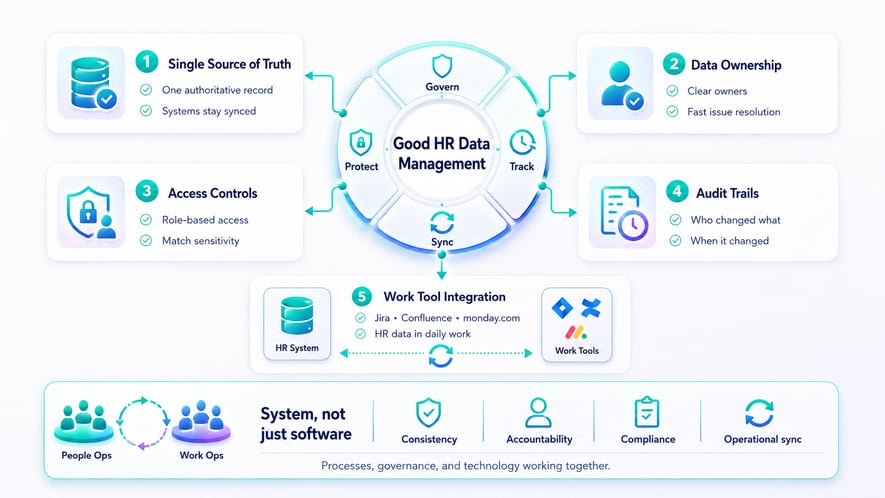
A single source of truth. Every piece of HR data should have one authoritative home. Other systems can reference or display that data, but changes should flow from a single source. This is the foundation of what is called HR master data management: the practice of maintaining a central, consistent record of employee data that all other systems stay synchronized with.
Clear data ownership. Someone needs to be responsible for the accuracy of each data category. Payroll data has an owner. Performance data has an owner. When data is wrong, there is a clear path to fixing it.
Access controls that match sensitivity. Not everyone needs access to everything. Compensation data should be restricted. Performance notes should be visible to managers but not peers. A good HR data management system enforces these boundaries consistently across tools.
Audit trails. For compliance purposes, organizations need to know who changed what and when. This applies especially to contract terms, compensation records, and any data covered by privacy regulations.
Integration with work management tools. HR data does not live in isolation. When a new hire joins, their information needs to reach the project management platform so they can be added to the right teams and boards. When someone changes roles, their access permissions in Jira or Confluence need to reflect the new responsibilities. Managing these connections manually introduces delays and errors. Tools like Jira and monday.com are where day-to-day work happens, and keeping HR data synchronized with them reduces the gap between people operations and project operations.
HR Data Management and Compliance
Data protection regulations have made HR data management a legal obligation as much as an operational one.
Under data protection regulations such as GDPR in Europe and CCPA in California, employees have the right to access their personal data, request corrections, and ask for deletion in certain circumstances. Organizations are required to process personal data only for legitimate purposes, retain it only as long as necessary, and protect it with appropriate security measures. The specific obligations vary by jurisdiction, but the underlying principles are broadly consistent.
This means HR data management needs to include retention policies: clear rules about how long each category of data is kept and what happens when the retention period ends. It also means maintaining records of processing activities: what data you hold, why you hold it, who has access, and where it is stored.
For teams using cloud-based tools, this extends to understanding where data is physically stored and whether the tool's data processing agreements meet regulatory requirements. A Confluence page containing employee performance notes, a monday.com board tracking recruitment pipelines, or a Jira project managing onboarding tasks: each of these holds personal data that falls within the scope of applicable privacy law.
Common HR Data Management Mistakes
Treating spreadsheets as a long-term solution. Spreadsheets work until they do not. They have no access controls, no audit trail, no integration with other systems, and no protection against accidental edits. For small teams they are a reasonable starting point; for growing organizations they become a liability.
Storing the same data in multiple places without a clear source of truth. When the same employee record exists in the HRIS, the payroll tool, and a shared spreadsheet, all three will eventually disagree. The cost of reconciling them is paid every time someone needs accurate data.
Conflating HR data management with HR software. An HR platform is a tool. HR data management is a practice. Buying a new HRIS does not automatically solve data quality problems if the underlying processes for collecting, updating, and governing data remain the same.
Neglecting offboarding. Employee data management tends to be thorough at onboarding and loose at offboarding. Access to tools gets revoked inconsistently. Data about the former employee remains in systems beyond its useful or legal retention period. Both create risk.
Building an HR Data Management Practice
There is no single right way to structure HR data management. The right approach depends on the size of the organization, the complexity of the tool stack, and the regulatory environment.
A useful starting point is a data inventory: a map of what HR data exists, where it lives, who owns it, and who has access. This exercise often reveals inconsistencies and gaps that were not visible before.
From there, the priorities are typically to establish a source of truth for core employee records, define retention policies for each data category, and build integration points between the HR system and the tools where work actually happens so that changes in one place propagate correctly to the others without manual intervention.
For organizations working with Jira, Confluence, or monday.com, this means ensuring that HR data flows into those platforms in a controlled way: new hires get the right access, role changes are reflected in project assignments, and sensitive data remains behind appropriate access controls. The broader question of how to build the right data infrastructure around these tools is covered in our guide to data management tools.
When the complexity of connecting HR systems with the rest of the stack grows beyond what manual processes or point-to-point integrations can handle cleanly, a more structured approach to data integration becomes relevant. Our guide to what is a data integration hub explains how this layer works and when it makes sense to introduce it.
FAQ
What is the difference between HR data management and an HRIS?
An HRIS (Human Resource Information System) is a software platform that stores and manages HR data. HR data management is the broader practice of governing that data: defining who owns it, how it gets updated, who can access it, and how long it is retained. An HRIS is one component of an HR data management practice, not a substitute for it.
What HR data is covered by data protection law?
Most data protection regulations, including GDPR in Europe and CCPA in California, cover any personal data relating to employees or candidates. This includes names, contact details, employment history, compensation records, performance evaluations, and any other information that can identify an individual. The specific rights and obligations vary by jurisdiction, but organizations should have a lawful basis for processing employee data, maintain records of processing activities, and be prepared to respond to data subject requests.
How do you maintain data consistency across multiple HR systems?
The most reliable approach is to designate a single source of truth for each category of HR data and ensure that other systems reference or synchronize from that source rather than maintaining independent copies. Where systems need to stay in sync automatically, integration tools can handle the data flow without manual intervention. Our guide to HR master data management covers this approach in detail.
What is the biggest HR data management challenge for growing companies?
The most common challenge is data fragmentation: the same employee information living in multiple systems that fall out of sync over time. This creates inconsistencies that affect reporting accuracy, compliance readiness, and the reliability of day-to-day HR processes. Establishing a clear source of truth early, before the stack grows too complex, is significantly easier than untangling fragmented data after the fact.
How long should HR data be retained?
Retention periods vary by data category and jurisdiction. Employment records are typically retained for several years after an employee leaves, while recruitment data for unsuccessful candidates may have a shorter retention window under applicable privacy law. Organizations should define retention policies for each data category, document them, and implement processes to enforce deletion or anonymization when the period expires.