
July 15, 2026
Vendor lock-in is the condition in which leaving a software provider costs more than staying, regardless of whether the product still serves you well. The cost is not always written in the contract. In most modern SaaS platforms, it lives somewhere less visible: in your data, and in how hard the platform makes it to take that data elsewhere.
Most discussions of vendor lock-in focus on cloud infrastructure, where the mechanisms are proprietary APIs and egress fees. For the tools that teams use every day, such as CRMs, HR platforms, and project management software, the mechanism is different and often more effective. This guide covers how data lock-in works, how to recognize it before you commit to a platform, and how to reduce the risk.
What Vendor Lock-In Means in Practice
The textbook definition of vendor lock-in is a dependency on a supplier that makes switching impractical due to costs, effort, or risk. That definition is accurate but incomplete, because it suggests that lock-in is something you can spot in the pricing page or the contract terms.
In practice, the strongest form of lock-in in SaaS platforms operates through data. A CRM that holds five years of customer history, an HR platform that stores every employee record and document, a project management tool that contains the entire operational memory of your team. The platform does not need to stop you from leaving. It only needs to make taking your data with you slow, incomplete, or expensive enough that migration never reaches the top of anyone's priority list.
How Data Lock-In Works
The mechanisms are rarely dramatic. Each one, taken alone, looks like a reasonable product decision.
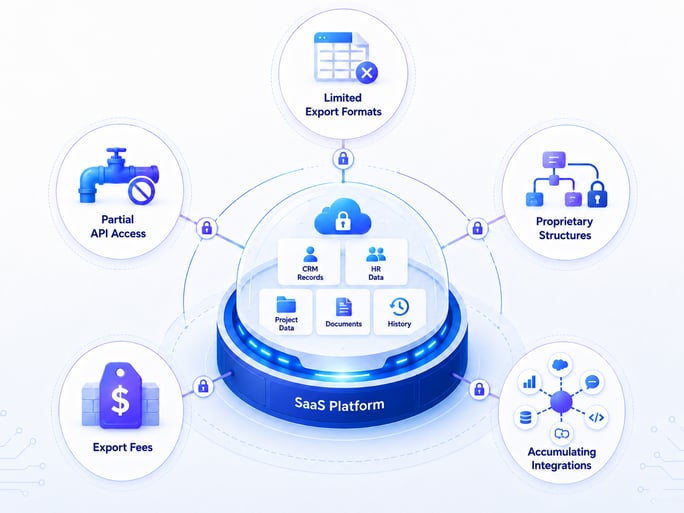
Limited export formats. The platform lets you export data, but only as CSV files that flatten relationships between records. Contacts export separately from their activity history. Tasks export without their comments and attachments. What you get out is technically your data, but reassembling it into something usable in another system requires weeks of work.
Partial API access. The API allows you to write data in but reads data out with restrictions, such as rate limits that make a full extraction take days, endpoints that skip certain record types, or historical data that is simply not accessible programmatically.
Proprietary structures. Custom fields, automations, templates, and configurations that took months to build have no equivalent representation outside the platform. The data can leave, but the logic around it cannot.
Export fees and plan gating. Full data export is available, but only on the enterprise tier, or through professional services, or with per-record charges that turn a migration into a five-figure project.
Accumulating integrations. Every tool connected to the platform is another dependency to rebuild after a migration. The deeper the platform sits in your stack, the higher the real cost of leaving it.
Why Vendor Lock-In Risk Is Growing
Two trends are making this more relevant, not less.
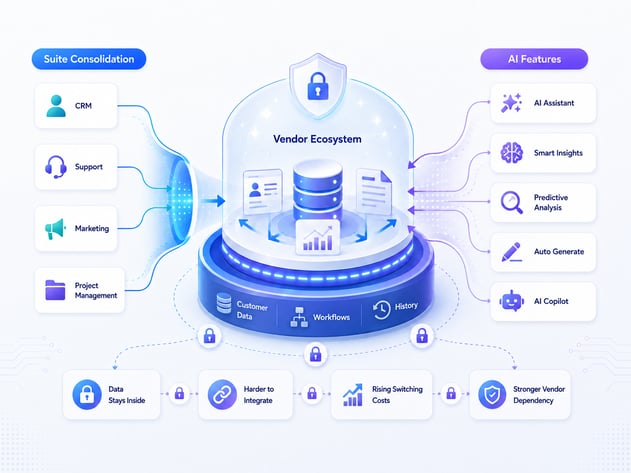
The first is the consolidation of SaaS platforms into suites. Vendors increasingly bundle CRM, support, marketing, and project management into one ecosystem. The more functions a single vendor covers, the more of your operational data lives in one place, and the higher the cost of ever moving it.
The second is AI. Platform vendors are building AI features trained and operated on customer data, which gives them a new incentive to keep that data inside their ecosystem and creates new questions about how it is used. For buyers, this adds a dimension to the evaluation: not just how do I get my data out, but also what is the vendor doing with my data while it is in.
How to Recognize Lock-In Before You Commit
The best moment to evaluate lock-in risk is before adoption, when you still have leverage and no sunk costs. These questions surface most of the risk:
- Can you export all your data, including attachments, comments, history, and custom fields, in a documented and structured format?
- Is full export available on your plan tier, or only on higher tiers?
- Does the API provide complete read access to every record type you will store?
- Are there documented cases of teams migrating away from the platform, and what did the process look like?
- What happens to your data after you cancel? How long is it retained, and in what form can you retrieve it?
A vendor with good answers to these questions has made data portability a design choice. A vendor with vague answers has usually made the opposite choice.
How to Reduce Vendor Lock-In Risk
For platforms you already use, the practical approach is to reduce the switching cost gradually rather than planning a dramatic exit.
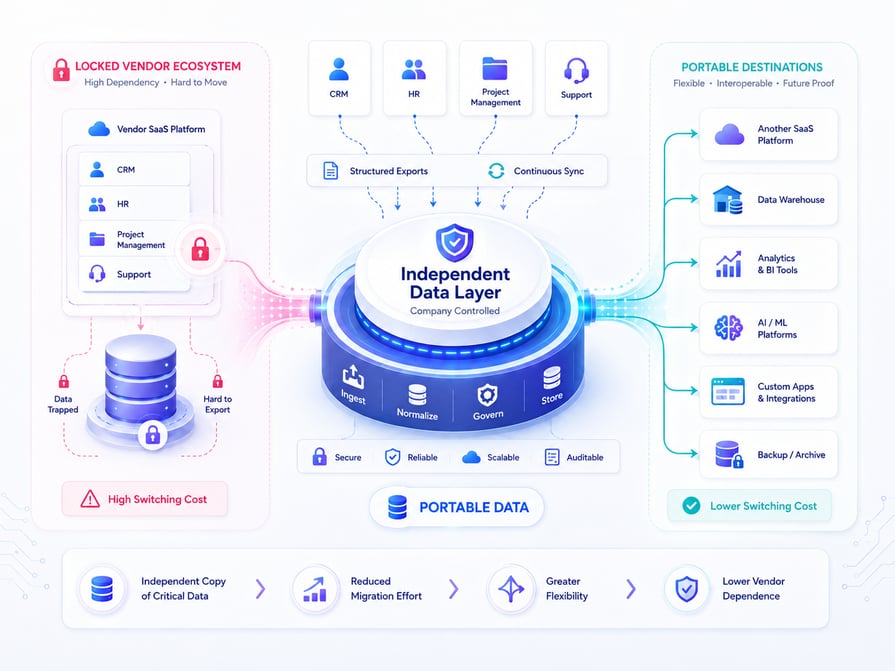
Keeping an independent copy of critical data is the foundation. If your customer records, project history, or people data exist only inside one vendor's platform, that vendor effectively owns your operational continuity. Regular structured exports, or better, a continuous synchronization of core data to a system you control, changes the balance. Our guide to what a data integration hub is explains how this kind of layer keeps data flowing between systems instead of accumulating in one.
Treating portability as a purchase criterion is the second lever. When data export quality carries the same weight in vendor evaluations as features and price, vendors notice. Teams that ask the five questions above during procurement consistently get better contractual terms on data access than teams that ask them at renewal.
The third lever is architectural. The more your critical data lives in systems designed to exchange it, rather than in closed ecosystems, the smaller any single vendor's leverage becomes. Our guide to data management tools covers how to think about the stack as a whole rather than as a collection of isolated purchases.
Lock-In Is a Data Question Before It Is a Contract Question
Vendor lock-in is usually discussed as a procurement topic, something to negotiate in contracts and pricing. For SaaS platforms, the real leverage sits elsewhere. A vendor that holds your data in forms you cannot fully retrieve has more power over your renewal than any contract clause, and that power grows quietly with every record you add.
The teams that handle this well treat data portability as an ongoing practice rather than an exit plan. They know what data they have, where it lives, in what form it can leave, and they verify it before signing rather than after. None of this requires abandoning the platforms you rely on. It requires making dependency a decision you keep making, instead of one that gets made for you.
FAQ
What does vendor lock-in mean?
Vendor lock-in means being dependent on a software provider to the point where switching to an alternative is impractical because of cost, effort, or risk. In SaaS platforms, the dependency usually comes from data: the platform holds your records, history, and configurations in forms that are difficult or expensive to move elsewhere.
What is an example of vendor lock-in?
A common example is a CRM that allows you to export contacts as a flat CSV file but provides no way to export the complete relationship between contacts, deals, communication history, and attachments. The data leaves the platform in a form that would take weeks of work to reconstruct in another system, which makes migration impractical even when a better alternative exists.
Is vendor lock-in always bad?
Not necessarily. Deep integration with a single vendor can bring real efficiency, and some degree of dependency is the natural result of using any tool seriously. Lock-in becomes a problem when it is asymmetrical: when the vendor's leverage grows while your alternatives shrink, and pricing or product decisions start reflecting that. The goal is not to avoid dependency entirely but to keep it a choice rather than a trap.
How do you avoid vendor lock-in?
The most effective measures are taken before adoption: verify full export capabilities, complete API read access, and data retention terms as part of the purchase evaluation. For platforms already in use, maintain independent copies of critical data through regular exports or continuous synchronization, and give data portability real weight when contracts come up for renewal.