
August 18, 2026
Behind the term "data management platform" sits a fairly concrete job. Somewhere in your organization, data is being produced faster than anyone can keep track of it. Records accumulate in the CRM, work items pile up in project tools, numbers land in spreadsheets and finance systems. A data management platform is the layer that takes responsibility for this material as a whole, so that the rest of the organization can find it, trust it, and use it.
This article explains how such a platform works in practice, what happens to data as it moves through one, and how to tell whether your organization actually needs one.
The Job a Data Management Platform Does
At its simplest, a data management platform sits between the systems that produce data and the people and tools that consume it. Its work happens in four stages.
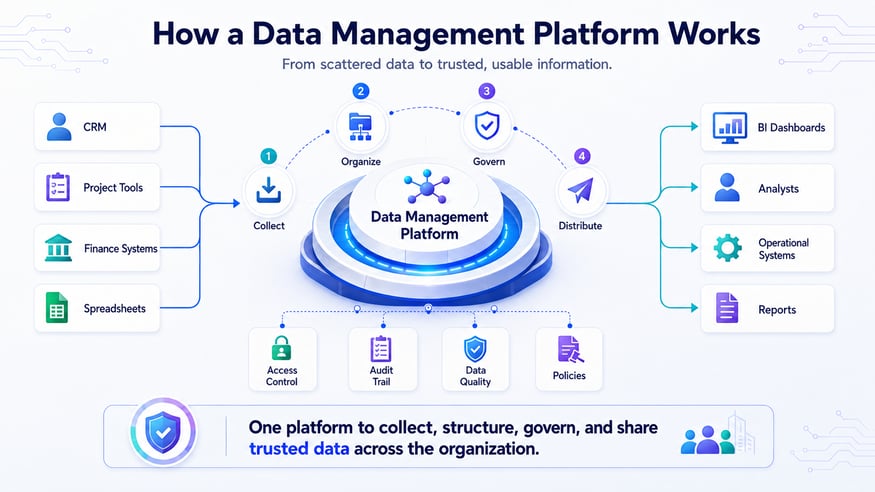
Collection. The platform connects to the systems where data originates. It pulls records through APIs, receives them through webhooks, or ingests files on a schedule. The scope varies by organization, but the principle stays the same. Data that used to live only inside individual tools becomes visible to a central layer.
Organization. Raw data from different systems rarely fits together. The same customer appears under three slightly different names, dates arrive in four formats, and every tool has its own idea of what a "project" is. The platform normalizes these differences into a consistent structure, deduplicates records, and maps relationships between them. This stage is where most of the value is created, and most of the effort spent.
Governance. Once data is centralized, the platform controls who can see and change it. Access rules, audit trails, retention policies, and quality checks live here. Governance is what separates a data management platform from a simple data dump, because centralizing data without controlling it mostly centralizes risk.
Distribution. Finally, the platform makes data available where it is needed. That can mean feeding dashboards and BI tools, answering queries from analysts, or pushing updated records back into operational systems so that every tool works from the same version of reality.
What Happens to a Record Inside the Platform
An example makes the flow concrete. Suppose a customer updates their company name, and the change is entered in the CRM.
The platform picks up the change through its connection to the CRM. It recognizes that this customer also exists in the support system, in the invoicing tool, and on two project boards, because it has already matched those records to a single identity. It validates the new value against its rules, records who changed what and when, and propagates the update to the connected systems that hold a copy.
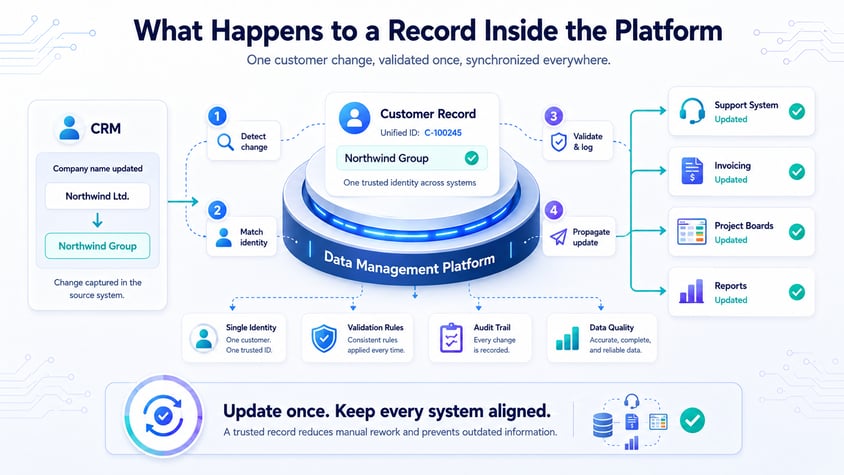
Without the platform, that same change travels by memory. Someone updates the CRM, intends to update the other systems, and gets to two of the four. Six months later, an invoice goes out under the old company name.
Data Management Platform, Warehouse, or Integration Hub?
The term overlaps with two neighbors, and the distinction matters when you are evaluating tools.
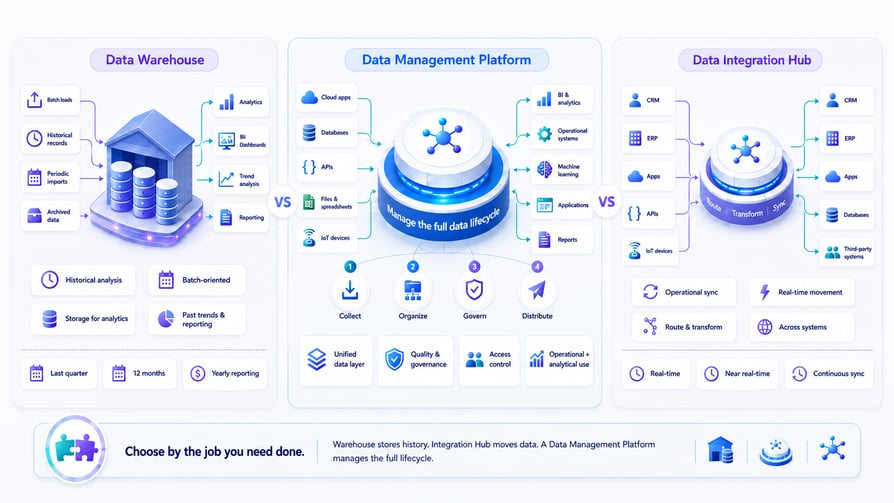
A data warehouse stores historical data for analysis. It is optimized for answering questions about the past, and it typically receives data in batches rather than managing it continuously.
A data integration hub focuses on movement. It keeps data synchronized between operational systems in real time, without necessarily storing it or governing it centrally. Our guide to what a data integration hub is covers this layer in detail.
A data management platform is broader than both. It covers the full lifecycle, from collection through governance to distribution, and in practice many implementations include a warehouse and integration capabilities as components. The comparison between storage architectures is covered in our guide to data hub vs. data warehouse.
When an Organization Needs One
The honest answer is that many organizations do not, or not yet. A team whose data lives in two or three well-integrated tools gains little from adding a management layer on top.
The need becomes real when specific symptoms appear. Reports built from different systems produce numbers that disagree, and nobody can say which version is right. Answering a basic operational question requires exporting from multiple tools and reconciling the results by hand. Compliance requests, such as finding every record related to one person, turn into multi-day investigations. New tools get adopted faster than anyone can keep their data consistent with the rest of the stack.
Each of these symptoms has the same root. Data has outgrown the informal practices that used to manage it. A platform does not fix the practices by itself, but it gives them a place to be enforced. Our guide to data management tools covers how to evaluate the options at different stages of that growth.
What This Means for Teams Working in Jira, Confluence, or monday.com
Work management platforms are among the biggest producers of operational data in most companies, and among the least connected to the systems that manage data formally. Project status, workload, delivery history, and team activity accumulate inside them and rarely flow anywhere else.
For teams in this situation, the practical starting point is usually not a full data management platform. It is making the data that already exists visible where decisions happen, by connecting work management tools to the reporting and data layers the company already has. Embedding live Power BI reports into Jira or monday.com, or keeping a Google Sheet synchronized with a Confluence page, solves a real part of the problem at a fraction of the cost. A dedicated platform becomes the next step when the volume and variety of data grow beyond what direct connections can handle.
FAQ
What does a data management platform actually do?
It collects data from the systems where it originates, organizes it into a consistent structure, governs who can access and change it, and distributes it to the tools and people that need it. The purpose is to make organizational data findable, trustworthy, and usable, instead of scattered across disconnected tools.
Is a data management platform the same as a DMP in advertising?
No. In advertising, DMP refers to a platform that manages audience data for ad targeting. This article covers data management platforms in the general enterprise sense, meaning systems that manage an organization's operational data across its tool stack. The two share an acronym but solve different problems.
What is the difference between a data management platform and a data warehouse?
A warehouse stores historical data for analysis and answers questions about the past. A data management platform covers the whole lifecycle, including collection, quality, governance, and distribution, and often includes a warehouse as one of its components.
Do small companies need a data management platform?
Usually not as a dedicated product. The need scales with the number of systems and the rate of data growth, not with headcount. Most small teams are better served by keeping their core tools well integrated and adopting formal data management practices before adopting a platform to enforce them.