
September 30, 2026
Every organization that runs on more than a handful of systems will eventually ask this question: how do we get a current and unified view of what is happening across all of them, without waiting hours or days for a warehouse report? The answer, for a specific class of problems, is an operational data store.
An operational data store, often shortened to ODS, is a database designed for near-real-time reporting and analysis of current operational data. It sits between the systems that produce data day by day and the systems that need to consume that data quickly, whether people, dashboards, or downstream applications. Unlike a data warehouse, which is optimized for historical analysis, an ODS is optimized for what is happening right now.

This guide covers what an ODS actually is, how it works in practice, when it makes sense to use one, and how it compares to the other database architectures organizations rely on.
The Core Idea Behind an Operational Data Store
The concept dates back to enterprise data architectures of the nineties, and it has a specific origin: warehouses were built for analytical queries over historical data, but many decisions need current data, not last month's snapshot. Somebody needed an intermediate layer that could hold recent operational data, updated frequently, and query it efficiently without competing with production systems.
The ODS was designed exactly for that gap. Data flows in from operational systems, arrives cleaned and integrated, and stays available for near-real-time reporting and lookups. When newer data replaces older data, the ODS reflects the change quickly, usually within minutes rather than hours.
Two properties define a well-designed ODS. It contains current data with limited history, typically a rolling window of days or weeks rather than years. And it holds integrated data from multiple sources, presented in a form that is ready to query without further transformation.
How an Operational Data Store Works
The mechanics are straightforward, and understanding them makes clear what an ODS is and is not.
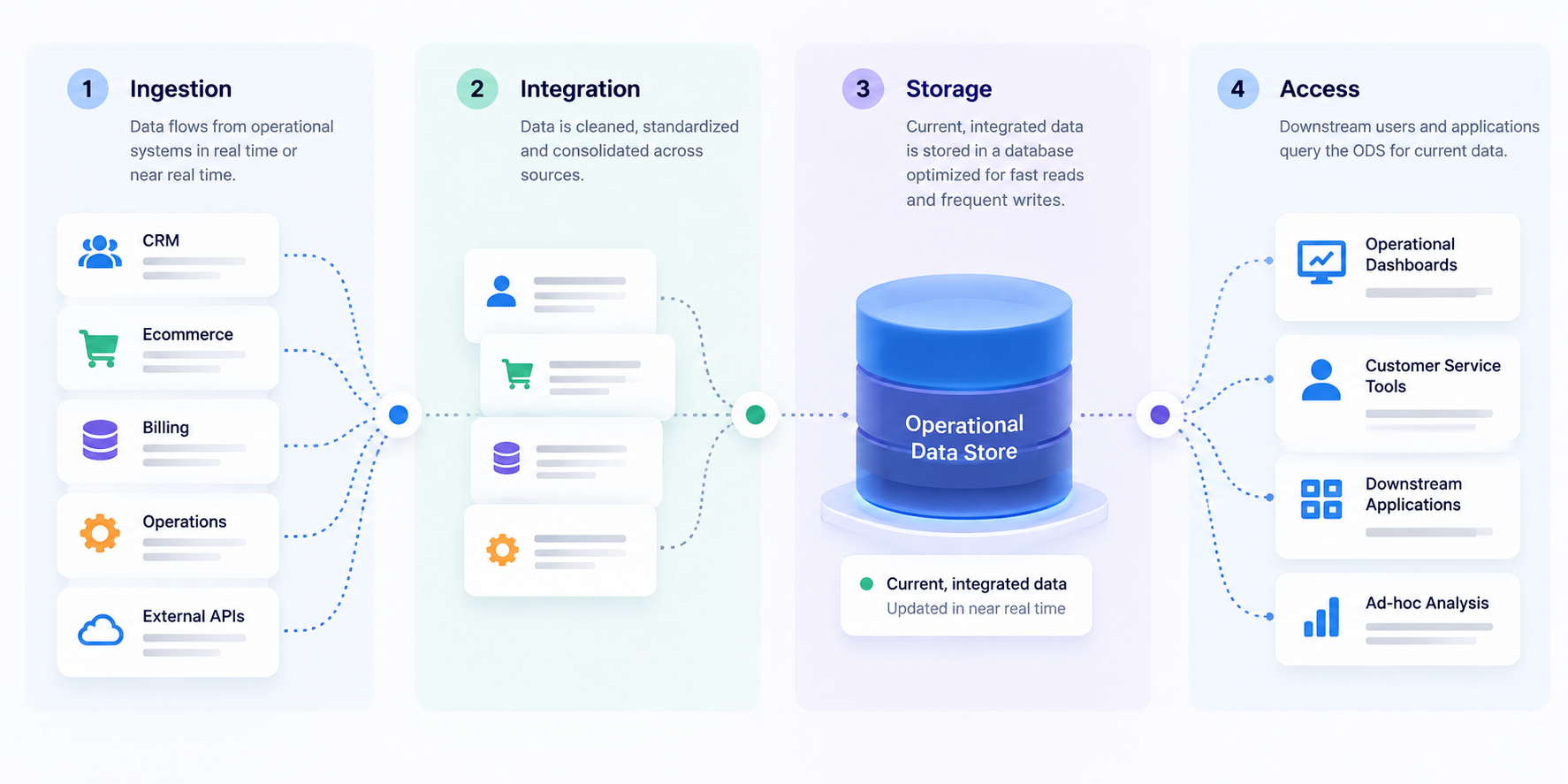
Ingestion. Data flows into the ODS from source systems on a continuous or near-continuous basis. This can happen through change data capture, event streaming, scheduled micro-batches, or direct API connections. The goal is a low latency between when a change happens in the source and when the ODS reflects it.
Integration. Because the ODS pulls from multiple systems, each with its own schema and conventions, incoming data has to be normalized and consolidated. A customer represented in three different formats across three systems becomes a single customer record in the ODS.
Storage. The ODS keeps the current state of operational data in a database optimized for both fast reads and frequent writes. This distinguishes it from a warehouse, which is optimized primarily for complex analytical reads over large historical datasets.
Access. Downstream consumers query the ODS for current data. These can be operational dashboards, customer service tools looking up account status, applications that need consolidated data across systems, or lightweight analytical queries that would be too slow or too expensive to run against production databases.
What an Operational Data Store Is Used For
The value of an ODS shows up in scenarios where current, integrated data matters more than deep historical analysis.
Customer service teams use an ODS to see a complete, current view of an account across CRM, billing, and support systems in one query. Finance and operations use it for daily reporting on active transactions, orders, or claims, where waiting for warehouse refresh cycles would be too slow. Regulatory reporting that requires current data across systems, such as position reporting in financial services, often runs against an ODS. And many organizations use an ODS as a staging layer that feeds cleaner, integrated data into their warehouse.
The common thread is that the ODS makes current operational reality queryable in one place, without forcing downstream systems to hit production databases directly.
Where the ODS Sits in a Modern Data Stack
Understanding what an ODS is means understanding what it is not, and how it relates to the other layers that organizations increasingly rely on.
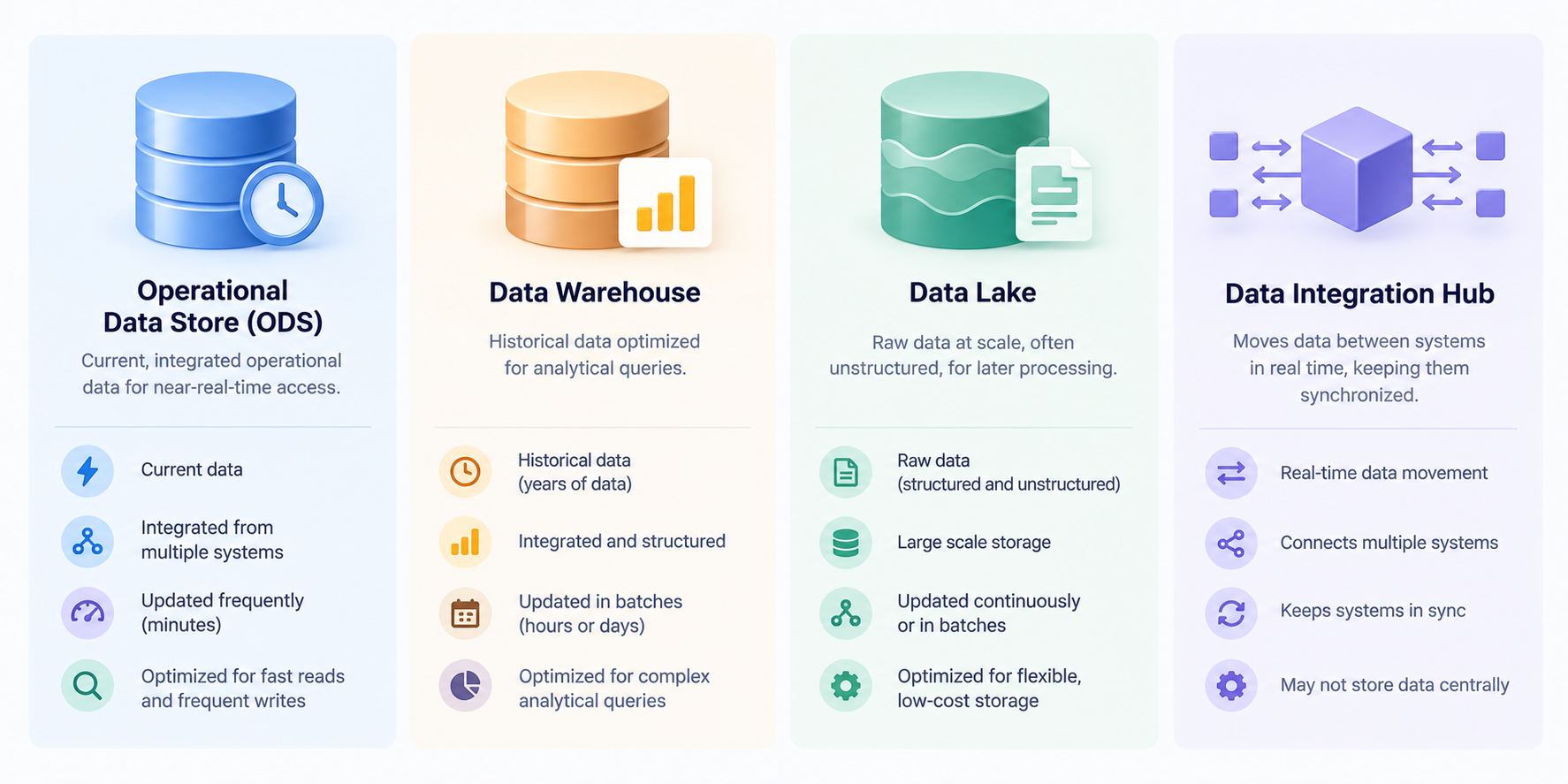
ODS vs. Data Warehouse. The warehouse holds historical data optimized for analytical queries. The ODS holds current data optimized for near-real-time access. They serve different questions: what happened over the last year versus what is happening now. Many organizations use both. Our full breakdown is in the guide to operational data store vs. data warehouse, and the broader comparison of storage-centric versus movement-centric architectures is in data hub vs. data warehouse.
ODS vs. Data Lake. A data lake stores raw data at scale, often unstructured, primarily for later processing. An ODS stores integrated, cleaned, current data ready to query. Lakes are broad; ODSs are focused.
ODS vs. Data Integration Hub. A data integration hub moves data between systems in real time, keeping them synchronized, without necessarily storing that data centrally. An ODS is a storage layer that holds the integrated data. The two can coexist: the hub handles movement, the ODS handles current-state querying. The distinction is covered in our guide to what is a data integration hub.
When an Operational Data Store Makes Sense
Not every organization needs one. An ODS earns its place when specific conditions are present:
- Current, integrated data from multiple systems is needed for daily operations or reporting
- Query load against production systems is creating performance issues
- Existing warehouse refresh cycles are too slow for the questions being asked
- Downstream applications need consolidated operational data through a stable interface
Where none of these apply, direct integrations between systems or point-to-point queries can be enough. Adding an ODS to a stack that does not need one adds complexity without proportional value.
The Terminology, Briefly
The term is sometimes abbreviated ODS, sometimes written out as operational data store. Both refer to the same architectural concept. In some contexts, ODS is used more loosely to describe any staging or intermediate storage layer, but the precise technical meaning remains what this guide covers: a database of current, integrated operational data optimized for near-real-time access.
FAQ
What is an operational data store?
An operational data store is a database that holds current, integrated data from multiple operational systems, optimized for near-real-time reporting and lookups. It sits between source systems and downstream consumers, providing a consolidated view of what is happening across the business right now.
What is the difference between an ODS and a data warehouse?
An ODS holds current operational data with limited history, updated frequently, optimized for fast queries on current state. A data warehouse holds large volumes of historical data, updated in batches, optimized for complex analytical queries over time. They answer different questions and are often used together.
Do modern companies still use operational data stores?
Yes. The concept dates from the nineties, but the need for current, integrated operational data has only grown as organizations run on more systems. Modern implementations use cloud databases, event streaming, and change data capture, but the architectural role is the same: a consolidated store of current operational data for near-real-time access.
What technologies are used to build an operational data store?
Common building blocks include relational databases or NoSQL stores for the ODS layer itself, change data capture or event streaming tools for ingestion, and ETL or ELT pipelines for integration. Specific technology choices depend on data volume, latency requirements, and existing infrastructure.